
Finding Where You Thrive: Using Astrology and Human Design to Understand Your Ideal Environment
A few weeks ago I took a random Friday off. It had been a really stressful stretch, and instead of doubling down and powering through even more work, I did the opposite. I just... stopped. Because I could feel that what my nervous system actually needed wasn't another to-do list. It needed a reset. And it wasn't going to get that from more work.
So I took a walk downtown, sat down with a matcha and did some people watching and a bit of writing. Then I wandered over to the Museum of Modern Art to finally see a Picasso exhibit I'd been wanting to visit for ages, and finished the morning with a really lovely lunch. It was a beautiful day on paper.
But here's the thing I noticed.
As I was walking around my hometown, a place I've lived in for the past twenty years, I felt... nothing. No nostalgia. No warmth. No "I'm going to miss this." And honestly? The absence of that feeling told me something really important. I have completely overstayed my welcome here. And if I'm being real about it, I'm not sure I ever truly felt welcome in this place to begin with.
It was never really my city. It never felt like home. The only reason it kept pulling me back, every time I tried to leave, was to meet Martin. I see that so clearly now. Once we found each other and started our family, that inner pull I'd had since childhood started making a whole lot of noise again. The pull to be somewhere else. To live abroad again. Because living abroad had always felt good. Really, really good.
And a few weeks before that Friday off, I was on my morning walk along the ocean in Palma, Mallorca. And it was the opposite of everything I just described. I was enjoying every single step. There's something about that part of the city, that stretch of ocean, that just soothes my soul. I feel lighter there. Like the air is different.
And as I walked, I started thinking about all the different places I've lived, all the offices I've commuted to on weekday mornings, and sometimes weekends too, let's be honest. I started thinking about how all those places made me feel. Some of them felt really good. Others felt truly, genuinely terrible. And the funny thing? The jobs with the nicest offices weren't always the ones that felt good. Sometimes the scrappiest workspace held the best energy. And vice versa.
So as I walked along that ocean, I was reminded of something I think we all know but rarely talk about enough. Environment matters. A lot. In life, in career, in business. When we spend significant amounts of time in a city, a home, or an office that doesn't feel right to us, it does something to us. It wears us down. It alters our experience of everything else.
And look, I'm not here to sell you the idea that life should be all unicorns and rainbows, because it really isn't. Some places will teach you exactly what you needed to learn. But I do believe we all deserve to be in an environment that supports us, because when the harder times inevitably come, and they always do, being in the right place makes it so much more bearable.
So that's what I want to talk about today. The importance of environment, how to tune in to how you actually feel in a place, and some really fascinating clues you can get from Astrology and Human Design about what kinds of environments your specific energy is designed to thrive in.
And before we get into it, just a quick note. You might want to watch this episode on YouTubebecause I'll be showing some chart examples, but stay on your podcast app if you prefer. You might also want to have your own chart pulled up, and if you're newer to Human Design, Astrology, and the Gene Keys, I have a free introductory guide that breaks everything down.
As always, these spiritual systems are tools. They're here to support you, not to dictate how you live. If something I share today doesn't resonate, leave it. But if something sparks curiosity, try experimenting with it. Trust your own inner knowing.
Let's start with Astrology, and specifically your moon sign.
The Moon in Astrology
Your moon sign in Astrology tells us what makes you feel emotionally nourished, what you need to feel safe and at home, and what kinds of environments allow you to recharge and function well. If your sun is your identity, your moon is your emotional foundation. It's what you need underneath everything else.
And when it comes to career and business, understanding your moon sign is genuinely useful, because the environments and conditions that allow you to feel good also tend to be the ones where you do your best work. So let me give you some examples.
A Taurus moon needs stability and groundedness. You don't love constant upheaval or rapid change, and that's not a flaw. That's your design. A career with slow, steady growth might actually be your sweet spot. And since Taurus is ruled by Venus, you might also find that you're most at ease in environments connected to beauty, art, food, or sensory pleasure.
A Capricorn moon feels good in structures where there's a clear long-term vision and measurable progress. You're not someone who thrives in chaos. Give yourself environments with clear goals and steady forward movement.
An Aries moon needs independence and a sense of momentum. Competitive environments where you can take initiative and move fast? That can feel really energizing for you.
A Virgo moon comes alive in environments where you can organize, refine, improve. You notice what others miss, and having a role that lets you use that detail-oriented mind is deeply satisfying.
A Scorpio moon needs depth and intensity. You're not built for surface-level work. Half-measures and meaningless tasks drain you. You need work that actually matters, something to sink into.
And me? I'm a Gemini moon, which means I need variety and conversation. Working from home sounds ideal in theory, but in practice? It can actually feel really draining if I'm isolated for too long, because I need interaction and the exchange of ideas to feel alive. I need things to keep moving.
Now, house placement matters too, not just the sign. A 12th house moon, for example, often needs regular solitude and retreat to recharge. A 10th house moon might feel a deep emotional need to be seen and respected in their public life and career. A 7th house moon thrives in one-to-one partnerships, so having a business partner could genuinely be the thing that makes everything click into place. And a 2nd house moon often feels most emotionally secure when they have a stable income, or work that aligns with their core values.
Your moon is just one piece of the chart, but it's a really important one because it points directly to what you need to feel okay. And you can't do your best work if you don't feel okay.
Human Design Definition
Now let's look at Human Design, starting with something called Definition.
Definition in Human Design tells us how energy flows in your chart. It's about which of your energy centers are connected to each other, and how many separate groupings of defined centers you have.
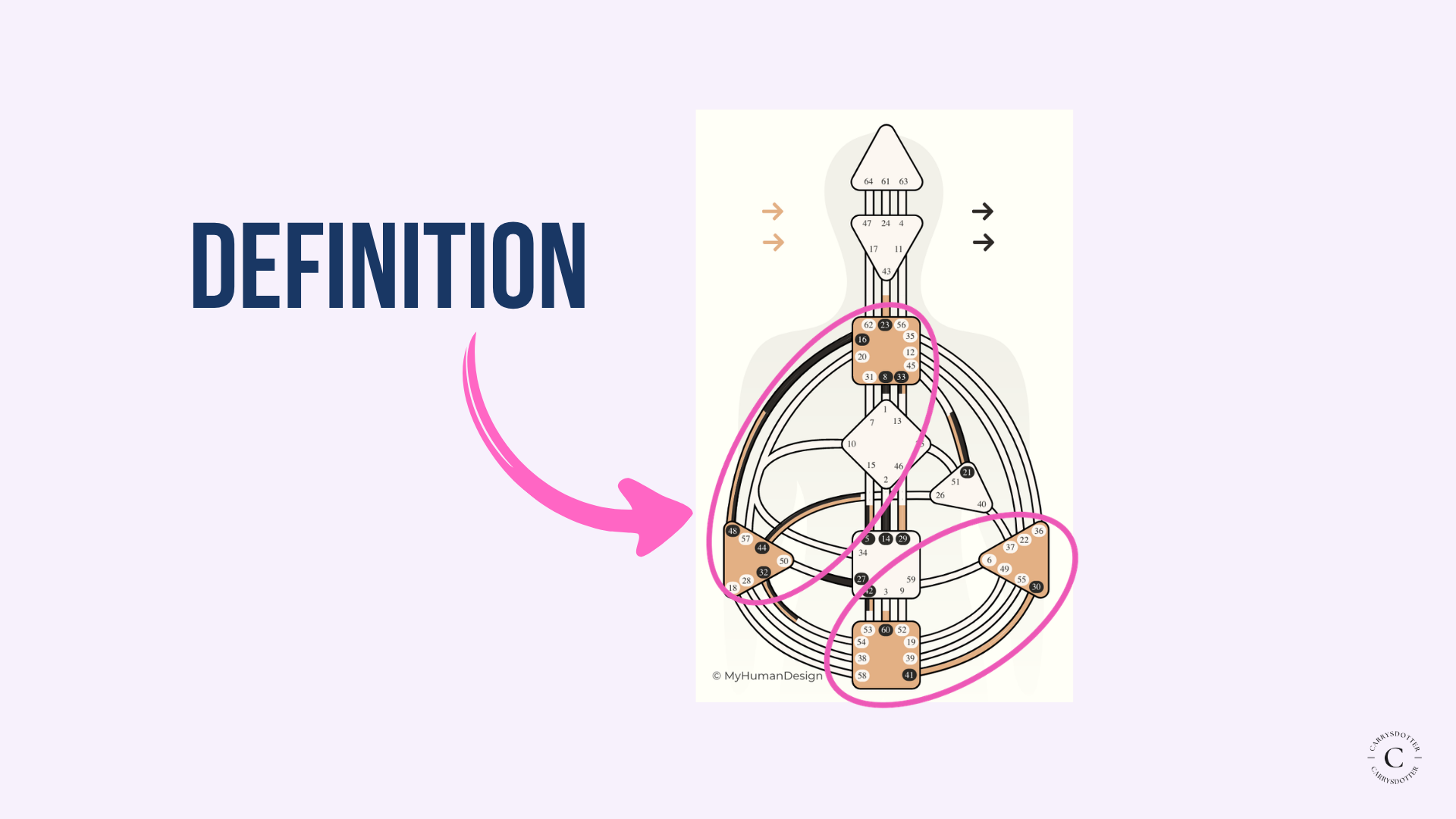
You can find this in your chart on any Human Design platform, and I always recommend Genetic Matrix, it’s just simply my personal preference.
There are five types of Definition, and each one gives you a clue about how your energy naturally operates, what you need in terms of people and environment, and how you process information and make decisions.
Let me walk you through them.
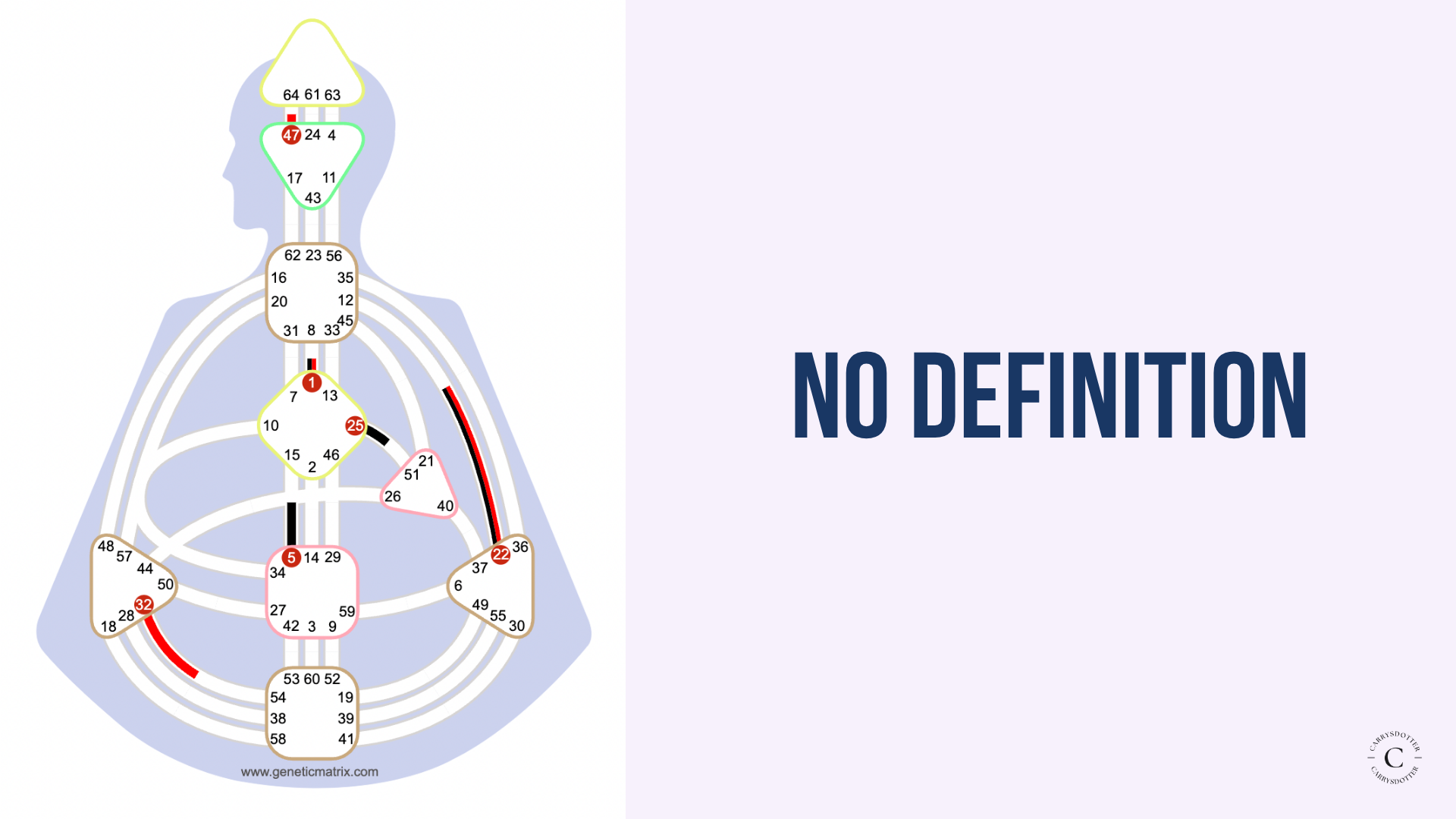
No energy centers are defined (colored in).
No Definition, which applies only to Reflectors, about one percent of the population. If you have no definition, you are deeply influenced by the environment and people around you. You absorb and reflect back the energy of wherever you are. And in a career context, this is actually one of your greatest gifts. You can sense whether an organization, a team, or a workspace is truly healthy, because you feel it completely. What you need is freedom and flexibility to move through different environments rather than being locked into one rigid structure for too long. Working in ways that give you variety, autonomy, and space to process over time works best for you.
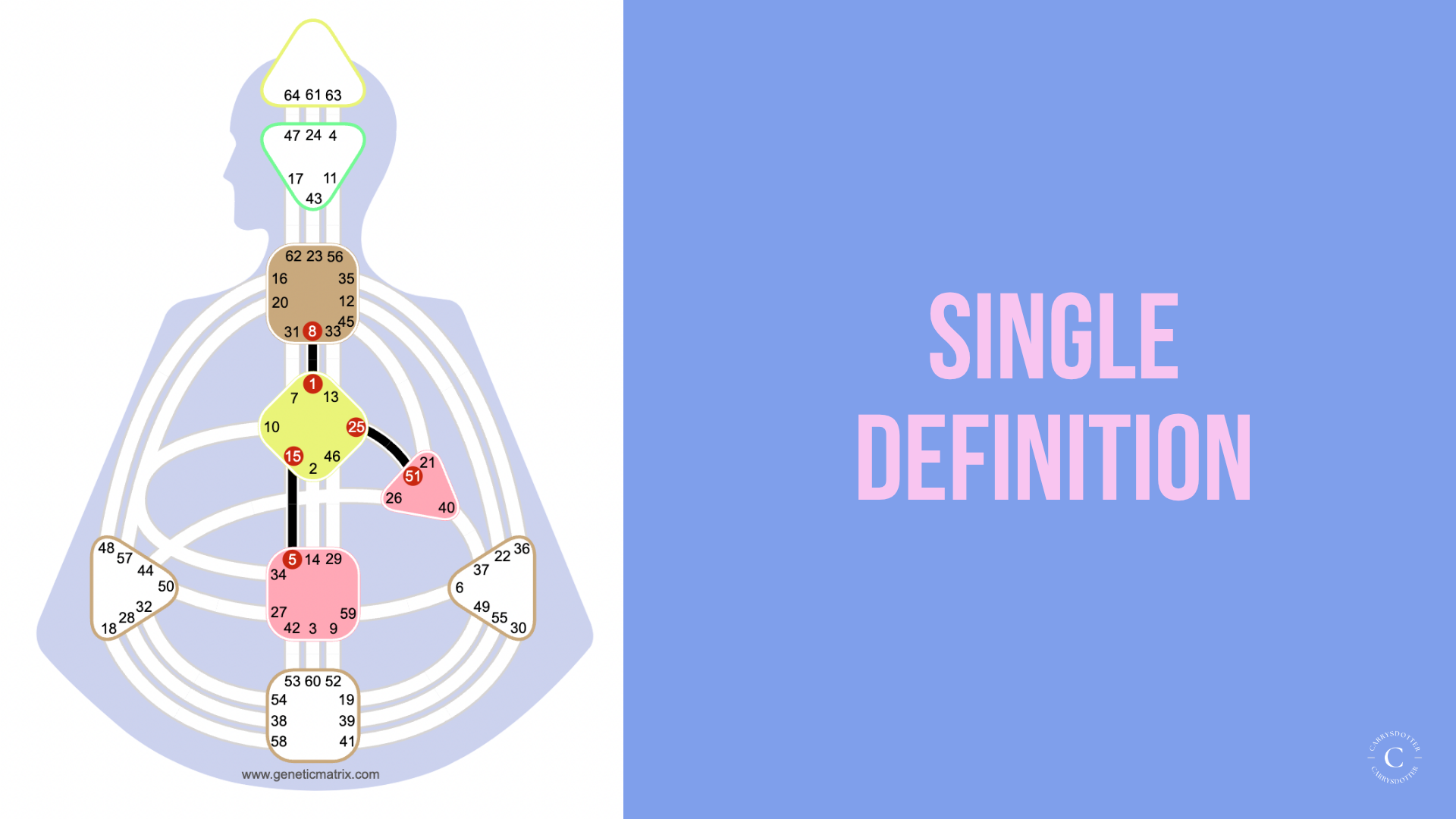
All defined energy centers are connected as one group through channels
Single Definition, about forty-one percent of the population. All your defined energy centers are connected into one group, which means you're self-contained. You have a consistent, independent flow of energy that doesn't depend on others to feel complete. In career and business terms, you're well suited to working independently, setting your own pace, and not relying on others to get into your flow. The environments and collaborations that serve you best are ones that respect your autonomy and don't require constant group input to function.
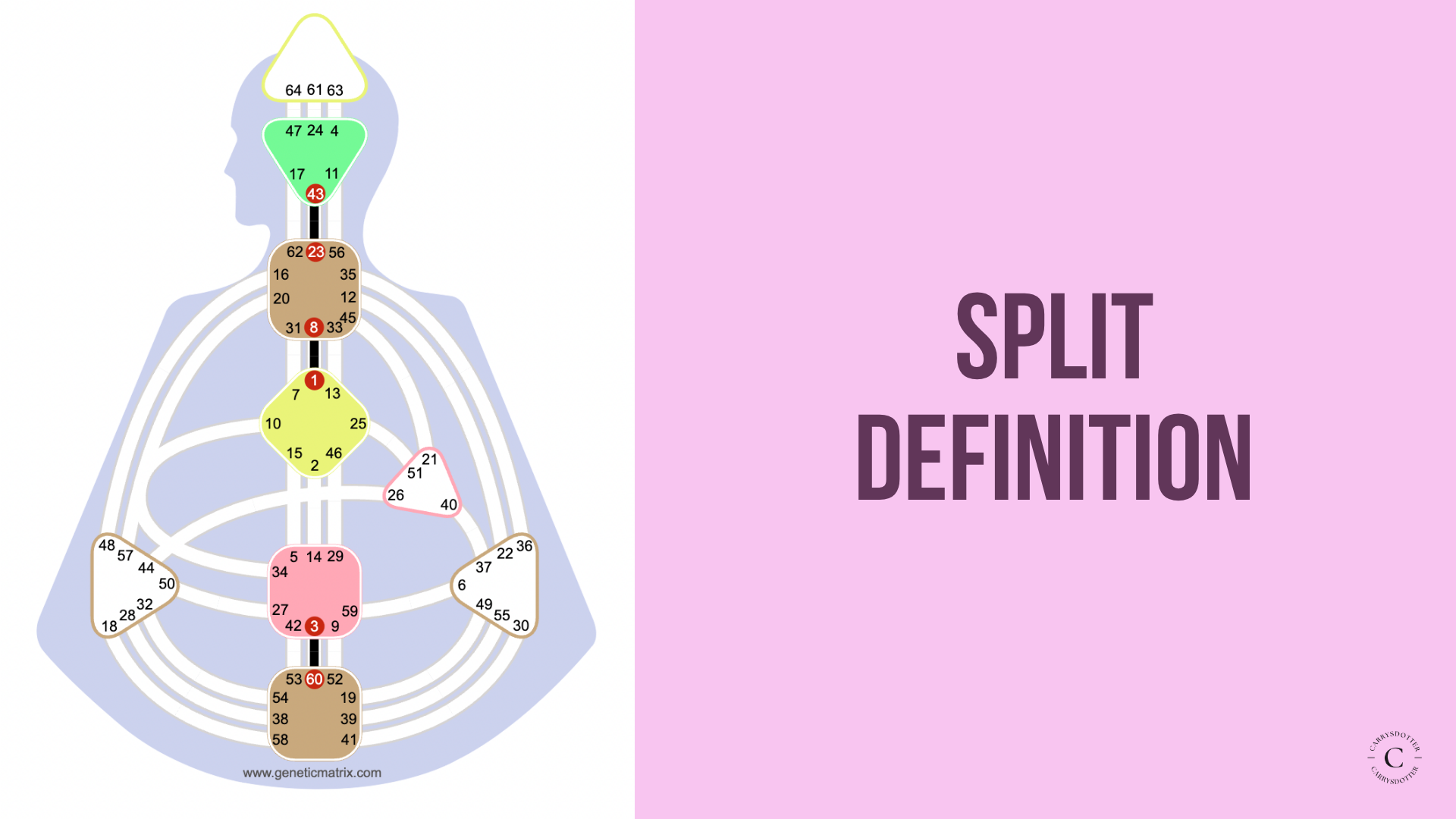
Two separate groups of connected energy centers (defined)
Split Definition, the largest group at forty-six percent. You have two distinct groupings of defined energy centers, and you naturally draw toward people and environments that can bridge those groups for you. In practical career terms, this means being around others genuinely helps you. Not necessarily talking to them constantly, but just being in proximity. A coworking space, a café, a team environment. Even if you work alone on your actual tasks, being around other people helps your energy flow better and helps you get clarity and move through stuckness.
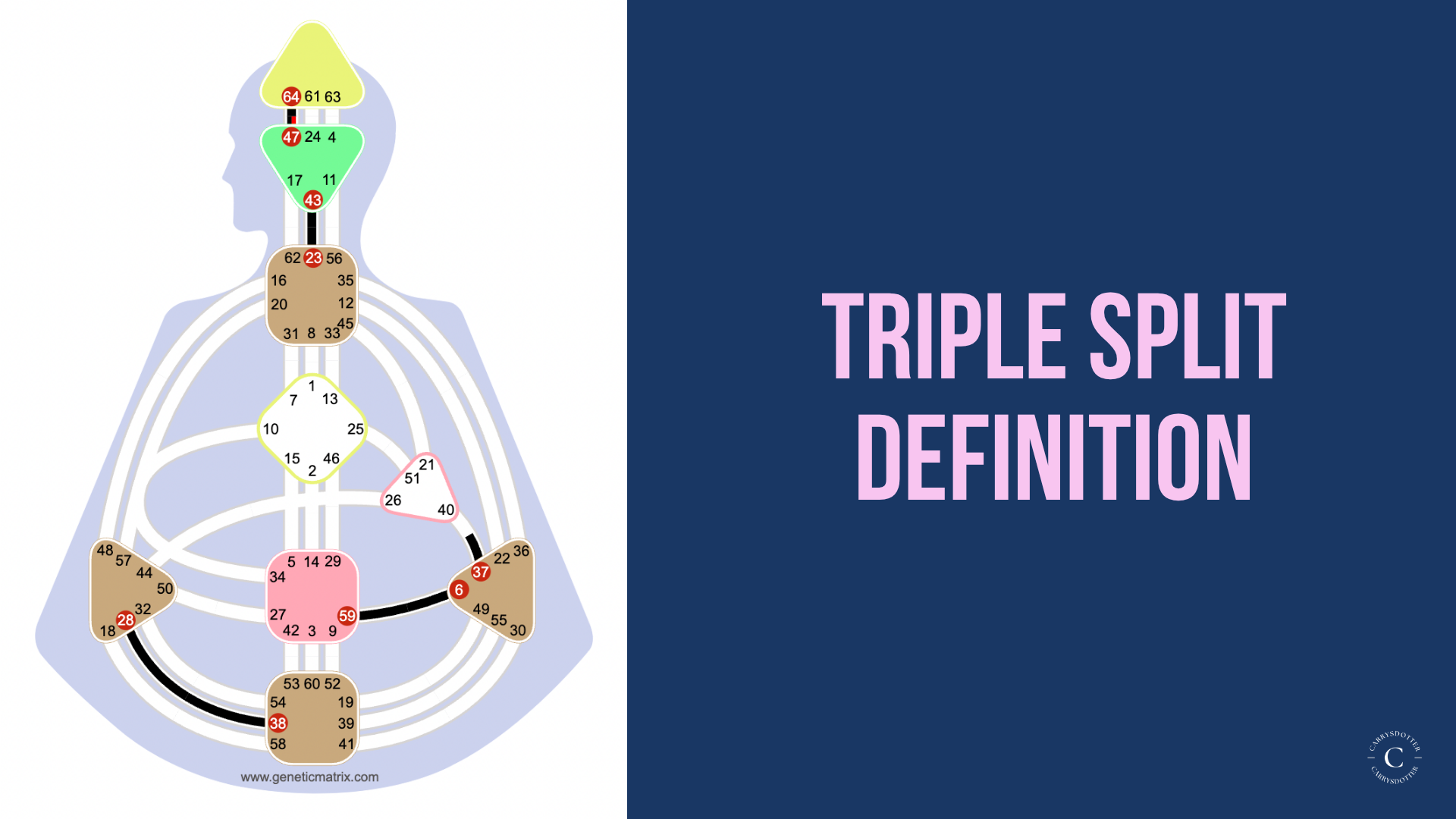
Three separate groups of connected energy centers (defined)
Triple Split Definition, about eleven percent of the population. You have three separate groupings, and like Split Definition, you benefit from the energy of others, but you also need more variety and movement than most. Sitting in the same space, with the same people, doing the same things day after day is genuinely draining for you. Flexibility isn't a preference, it's actually a requirement for your energy to flow well. Moving between different environments and people throughout your week helps you process, think clearly, and stay energized.
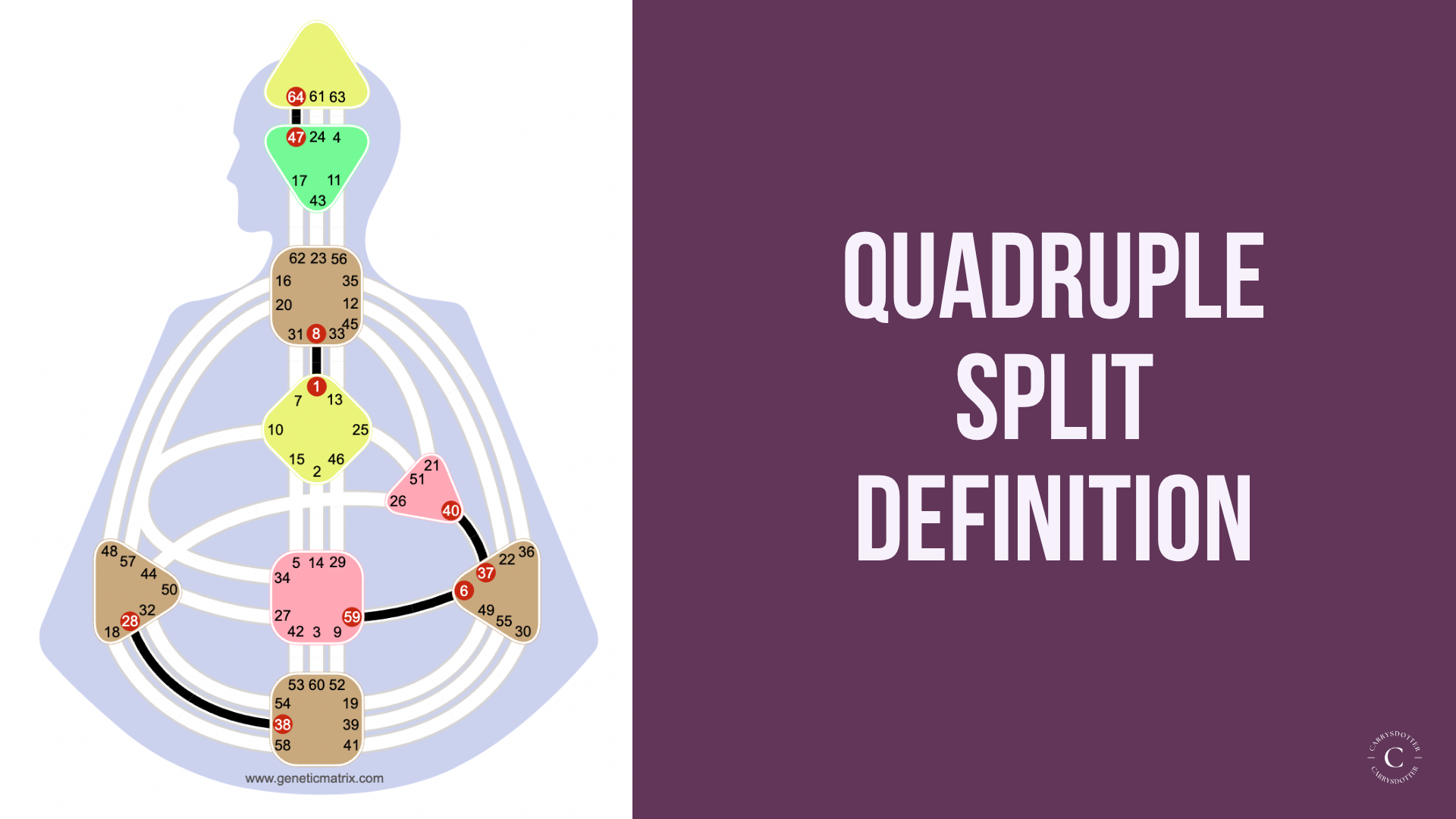
Four separate groups of connected energy centers (defined)
And Quadruple Split Definition, just one percent. You have four groupings, and you benefit from diverse relationships that can activate different parts of your chart. Your process is unique and tends to be slower than others, and that's completely by design. The best career environments for you are ones that allow you to operate at your own pace, with a rich variety of people and stimuli, without pressure to keep up with someone else's timeline.
Human Design Environment
Now let's get into what might be my favorite Human Design concept when it comes to this topic, the Environment variable.
In your Human Design chart, there are four arrows surrounding your head area. Two on the left, two on the right. Your environment variable is the bottom left arrow. And it tells you what kind of physical environment your body is literally designed to thrive in.
Now before I go through the six types, I want to name something important. These names are descriptive, not literal. You don't necessarily need to go live in a cave or work on a literal mountain. Think of them as capturing the energy, the vibe, the feel of what your body needs around it.
Also, the direction of that bottom left arrow tells you something important too. If the arrow faces left, you have what's called an active body. You're activated and stimulated by your environment. You're designed to be in it, moving through it, being seen within it. A consistent space that gives you some structure tends to work well for you. If the arrow faces right, you have a passive body. You're designed to be the observer rather than the observed. You feel better watching from a slight distance, taking things in rather than being in the middle of everything.
Now, the six environments.
Caves. This environment is about security and control over your space. Not a literal cave, but a place where you can see who comes and goes, where you have some dominion over the boundaries of your environment. Think a private office where you control the door, a workspace that's clearly yours, a home setup that feels contained and protected. You feel best when you have a sense of safety and enclosure around you.
Markets. This is all about exchange. You thrive in dynamic, busy environments where there's a constant flow of interaction, variety, and energy moving between people. High-traffic environments, bustling spaces, roles that involve lots of different people and conversations, that's where you come alive. Working solo in a quiet room is probably not your ideal.
Kitchens. Think about what a kitchen feels like. Buzzy, creative, transformative. Things are being made. Energy is constantly moving. You thrive in environments where there's creative activity, production, things being brought into existence. If you're an entrepreneur working from a very still, quiet home office, you might find it oddly unstimulating, and knowing this could be the thing that shifts everything. Get yourself into some buzzy environments a few days a week and see what happens.
Mountains. This is about elevation and perspective. Again, not always a literal mountain, although that can genuinely help. You feel best when you're elevated, literally or figuratively. Higher floors, wide open views, environments where you can see the whole landscape rather than being in the middle of it. It's also about the quality of thought that happens at elevation. A higher perspective on things, seeing how everything connects, working with people who think expansively. I'm a Mountains person, and I actually think about this when I set up my workspace. We live on the ninth floor, and I've experimented with where I put my desk so I can feel that sense of perspective and view while I work.
Valleys. This is about groundedness, yet openness and flow. You're drawn to lower-lying, natural environments with a certain acoustic quality, places where you can hear and feel things moving around you in a natural way. You want to feel connected to your surroundings, close to community and resources, while still having a sense of ease and retreat. It's less about the buzz of Kitchens or Markets and more about organic, natural flow.
Shores. Transitional spaces. Edges where two environments meet. Like a shore, where water meets land. Like a porch, where inside meets outside. Like living on the outskirts of a city where urban and natural collide. You thrive in environments where there's a sense of transition, of moving toward something, of being at the boundary between two different energies. These in-between spaces feel generative and alive for you.
Astrocartography
And now, a topic I have to be honest about before I dive in. This is not my primary area of expertise. I am a career and business astrologer first and foremost, and my deep work is in natal chart interpretation and how it applies to your career and vocation. However, I find astrocartography absolutely fascinating, and I've done a lot of personal research on it, partly because my own chart tells such a clear story here.
So what is astrocartography? It's a branch of astrology that maps where each planet in your natal chart was positioned at the moment of your birth, but plotted across the globe rather than just in your chart wheel. The result is a world map overlaid with planetary lines. Wherever you live or travel in the world, you're sitting within the influence of certain planetary energies, and those energies color everything. How life feels, what you attract, how easily things flow, and yes, how your career and business unfold.
Let me tell you what I mean through my own experience. I mentioned walking in Stockholm and feeling nothing. Life has always felt a little heavy here for me, like I have to push constantly, like things require more effort than they should. And when I looked at my astrocartography map, I saw that in Stockholm I'm living on my Mars line.
Mars is the planet of drive, ambition, and action, but it's also the planet of friction and conflict. Living on your Mars line means life is energizing but activating, often in challenging ways. You'll work hard, you'll feel driven, but things can also feel combative and exhausting. Like you're always having to fight for what you want. That's basically my experience of Stockholm summarized in one sentence.
In Palma, on the other hand, I'm on my Jupiter line. Jupiter is the planet of expansion, abundance, opportunity, and genuine good fortune. Living on or near your Jupiter line can feel like life opens up in ways that aren't entirely explainable. Doors appear. Things feel lighter. There's a quality of ease and spaciousness that's just... different. And that's exactly how Palma feels to me. Lighter. More open. Like I can breathe differently there. So yes, I am very happy about our move this summer.
Now, from a career and business perspective specifically, the line that tends to be most significant is your MC line. The MC, or Midheaven, from the Latin "Medium Coeli" meaning "middle of the sky," is the highest point in your natal chart. It represents your career, your public image, your reputation, and how you're seen in the world. In astrocartography, wherever your MC line runs on the map is where this energy is most activated. Living near your MC line tends to support professional visibility, career growth, and being recognized for what you do.
To give you a few examples of what different combinations can feel like from a career angle:
Jupiter on your MC line can bring expanded opportunities and a sense of professional flow and visibility. Things tend to grow more easily here.
Sun on your MC line often means your identity and life purpose feel deeply aligned with your career when you're in that location. You shine professionally.
Venus on your MC line tends to support creative industries, beauty, relationships, and work where being well-liked matters.
Mercury on your MC line often helps with communication, writing, teaching, and anything where clarity of thought and speech is important.
My Sun is on my Midheaven line in Saudi Arabia. And as a woman who would not have basic human rights there, that's a hard no for me. I have Jupiter on my MC line in Bali, which is interesting and maybe worth exploring someday. But right now, Palma is where I want to be.
And again, I want to be transparent here. Astrocartography is a rich and complex field and I am not an expert in it. If this lights something up for you, I'd encourage you to explore it further with someone who specializes in it. What I've shared is based on my own research and experience. Take it as a starting point, not a complete picture.
Living and Moving Abroad
There's one more thing I want to touch on, because it connects to everything we've talked about today. And that's the desire some of us have to live abroad, or at least, to not be rooted to the place where we grew up.
I've lived in the US for four years, the UK for two, and I felt genuinely good in both places. And now moving to Mallorca feels like the most natural and exciting thing in the world. So are there astrological or Human Design clues that point toward this? Yes, actually.
If you have a lot of placements in the ninth house of your chart, that house rules international travel, foreign cultures, and cross-cultural communication. Multiple planets there can indicate a real pull toward life beyond your home country.
Sagittarius placements are another indicator, since Sagittarius is the sign most associated with travel, exploration, and the love of experiencing life in different cultures.
And this is something I learned relatively recently from one of my favorite astrologers that I've taken classes with. The twelfth house is traditionally associated with the subconscious, the mystical, and things that are hidden. But there's an interpretation I've heard from more than one astrologer now that the twelfth house also represents foreign lands. And people with significant twelfth house placements, especially the moon there, often feel more at home abroad than they do in their country of origin.
I am a twelfth house moon. And I have genuinely always felt more at ease when living abroad. Make of that what you will.
Wrapping Up
So. Environment. It's more than just a backdrop to your life. It's an active ingredient in how you feel, how you work, how you make decisions, and ultimately, how your business or career unfolds.
Your nervous system is picking up information constantly about the places and spaces you're in. Sometimes that information is whispering. Sometimes it's shouting. And learning to listen to it, whether through tuning into how your body feels or by going a little deeper with tools like your moon sign, your Human Design definition, your environment variable, or your astrocartography map, is a really valuable investment in yourself.
If this episode sparked something for you and you want to explore what your specific chart is saying about the environment that would genuinely support your career, your business, and your life, this is exactly the kind of thing I love to dive into in my one-to-one intensive sessions. We look at your complete chart across Astrology, Human Design, and the Gene Keys, and we get really specific about what your design is calling for. What would feel right. What you might be resisting. And how to move toward it in a way that's actually sustainable.
And if you're newer to these systems and want a starting point before anything else, as I mentioned in the beginning, my free Introductory Guide to Human Design, Astrology, and the Gene Keys is also there waiting for you.
Thanks so much for being here today. If this episode resonated, please leave a review, subscribe if you haven't already, and share it with someone who's been feeling a little out of place lately. Because sometimes just naming that feeling is the first step.
I'll see you next time.